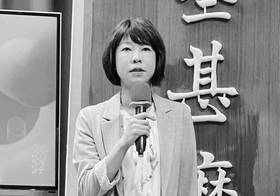
It’s true that Gou is still an unknown political entity, and – if elected – he may end up shocking the pundits and fighting China until his last breath in the name of Taiwan’s independence.
Terry Gou, a straight-talking businessman with a mercurial temper, no political experience, a disdain for the government of his country, and a vast personal fortune at his disposal is running for president. Sound familiar?

Just like current US prez Donald Trump – whose successful 2016 run is said to be his inspiration for entering the political fray – Gou is one the wealthiest people in his nation, Taiwan, with his net worth estimated at US$8 billion. Putting aside the issue of where exactly Gou’s loyalties lie (his company, Foxconn, is an integral part of the economic landscape of China, employing over a million workers there, while he himself has met with the upper echelons of the CCP, including Xi Jinping), a more pertinent question is whether or not Taiwan really needs a businessman running the show.
While some voters dissatisfied with the current political situation there – like many who voted for Trump in 2016 – may jump at the chance of electing a businessman to shake up the system, if we’ve learned anything from Trump’s term in office, it’s that electing a headstrong billionaire with no experience will certainly shake things up, but not necessarily in a good way …
So far, the US mogul’s presidency has been characterized by unprecedented chaos and confusion, as Trump “has the record for White House staff turnover, for cabinet turnover and … for the highest turnover within a single department,” according to scholar Kathryn Dunn Tenpas. Pick up a newspaper on any given day, and you’re sure to read about the latest scandal or controversy unfolding in the administration. So while it may sound like a good idea to elect a political outsider to drain ‘the swap’, the reality is much more complex than that. In the case of Trump, at least, it’s seems as though his hardnosed corporate leadership style has not translated all that well into the government realm, resulting in serious instability at the top.
Additionally – if Trump’s actions are in any way indicative – a profit-first (principles-second) CEO-type leader may not always obey the ethical rules and guidelines of an advanced democracy, which exist to keep the various governing powers in balance. To mention only a few examples: Trump’s dubious firing of the Director of the FBI, James Comey, when he wasn’t happy with the direction the Russia investigation against his campaign was taking; his continual lambasting of the press when they produce stories he doesn’t like; and his administration’s blanket refusal to cooperate with the investigations of the Democrat-controlled House of Representatives, whose traditional function is to provide oversight of the executive branch. Basically, the attitude of a hardcore businessman towards to the well-honed machinery of government seems to be, “It’s my way or the highway, bub,” and – regardless of which side of the political spectrum you’re on – that can’t be a good thing for democracy.
Finally, just like Trump, who refused to fully separate himself from his business operations upon assuming the presidency, it’s not clear Gou would completely distance himself from Foxconn if elected. In the words of Taiwan political expert Lev Nachman, “In the same way Trump only marginally divested from his assets when he became president, I would not expect Gou to truly move away from his [company]”. Obviously, this creates a major conflict of interest, as the person in charge may be tempted to put his own good above that of the whole. To take just one example of this from Trump’s presidency, many people wonder if there’s a simple – and disturbing – reason he didn’t take a hard line against the Saudi government after the brutal murder of journalist Jamal Khashoggi. Could it be because, as he’s said in the past, “I get along great with all of [the Saudis]. They buy apartments from me. They spend $40 million, $50 million. Am I supposed to dislike them? I like them very much.”? Essentially, if you have a wealthy tycoon in office, it may be hard for him to remove himself from his business interests, as politics and commerce are often intertwined. As Nachman says, “I would be greatly concerned with Gou’s ability to separate his business from his political endeavors. Given Foxconn’s position within the Chinese economy and Gou’s political ideals, I’m not sure he even can or wants to.”
It’s true that Gou is still an unknown political entity, and – if elected – he may end up shocking the pundits and fighting China until his last breath in the name of Taiwan’s independence. But then again, Trump was an unknown entity in 2016, and although he claimed to be a populist, so far he’s: (1) signed a tax bill that benefits corporations and upper-income earners over others; (2) obsessively attempted to repeal Obamacare, which mainly aids the poor and uninsured; and (3) led an ongoing campaign of deregulation that’s left more US workers vulnerable to exploitation and injury. But maybe that just proves the truth of the old adage that ‘a leopard never changes its spots’?
Gou, like Trump, is known for attacking the press and charging it with disseminating ‘fake news’, as well as having a harsh personal style – one that recently led him to walk out of a public forum when a DPP lawmaker didn’t look at him while he was speaking. He also seems to have a penchant for controversial quotes, as he once stated that “the harem should not meddle in politics” in reference to his wife’s objections to him running for office (the obvious implication being that a president isn’t so much a servant of the people as an emperor), and has dropped the bombshell that “democracy alone does not provide food to eat.” While this latter statement may technically be true, every voter in Taiwan should be asking themselves: ‘But then what exactly is the alternative?’
Author / Peter K. Thompson